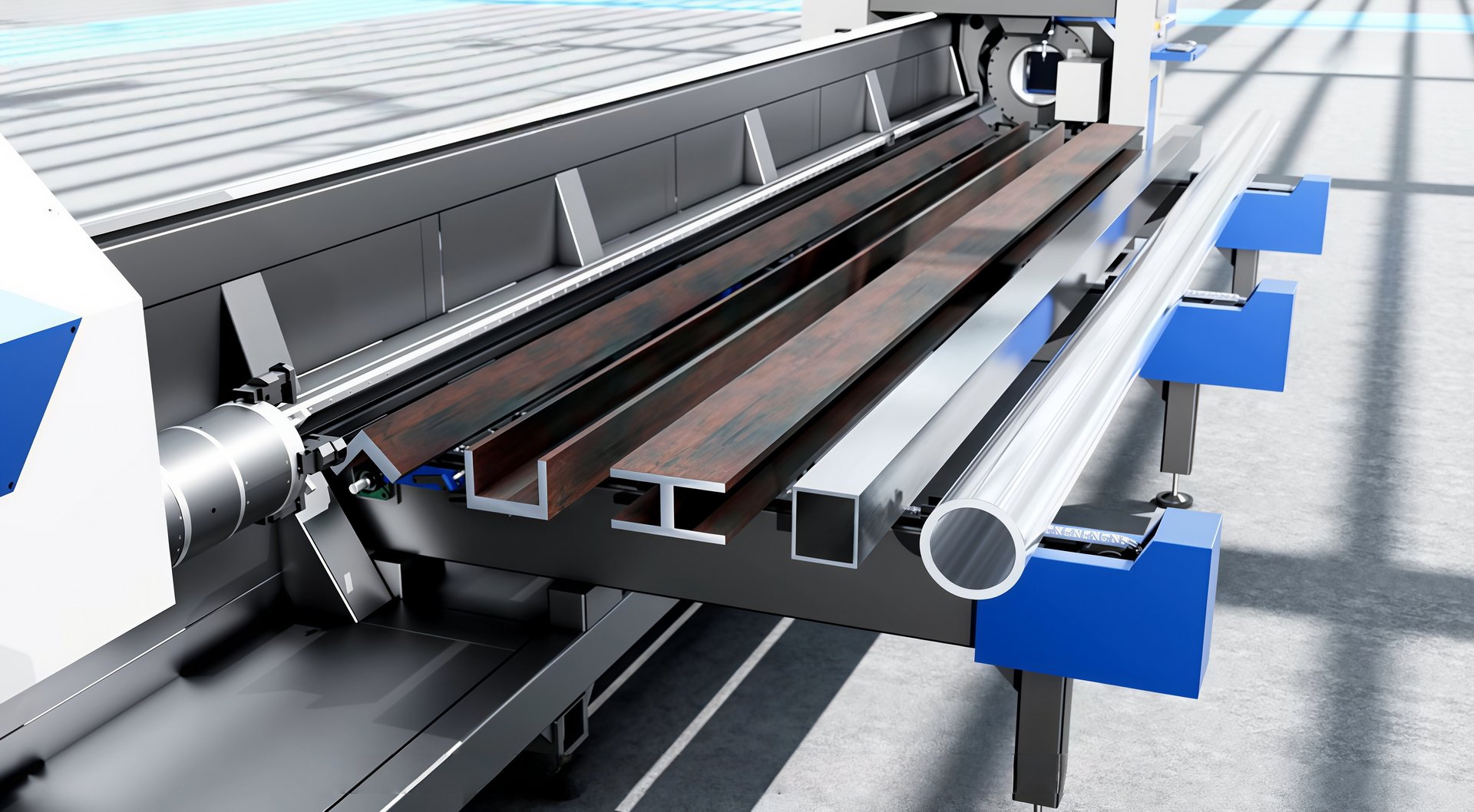
The Vantix TPC line brings tube, pipe and structural profile cutting in-house, in three chuck configurations. Chuck count is the buying decision on this line, and it changes every capacity figure. A 2-chuck machine is the entry platform for standard tube. A 3-chuck adds follow-up support for long, lighter workflows where yield matters. A 4-chuck is what you specify for ultra-long, thin-walled or large-diameter tube.
Vantix's spec sheet publishes the platform maximum: up to 48 ft (14 m) tube length, up to 40 in (1000 mm) round diameter, up to 36 x 36 in (900 x 900 mm) square or rectangular, and up to 1 in (25 mm) wall thickness, material-dependent. Vantix's brochure publishes the entry 2-chuck configuration at 20 ft tubes and 220 mm round diameter. Both are correct; they describe different machines. Ask which configuration a quoted number belongs to before you compare it against another vendor.
Positioning accuracy is 0.05 mm. Chuck rotation runs 120 to 150 rpm. Servo follow-up support keeps accuracy on long or thin-wall tube, semi-automatic loading handles six to seven tubes per cycle, and tail waste is near-zero on 3-chuck and lower again on 4-chuck. The Z-axis is fully sealed against contamination, and CAD import with auto-nesting feeds it directly. Round, square and rectangular tube are supported alongside H-beam, I-beam, C-channel, angle and Z profiles. Parts come off the machine with miter cuts, copes, hole patterns and notches already in place.
Two-year warranty, five days of on-site training, a one-year spare parts kit stocked in Lumby, British Columbia, a 24/7 Canadian support line, and a 48-hour on-site response commitment across Western Canada. Parts are stocked in Lumby, not overseas.
The full line overview sits at tube and profile laser cutting. If your work is predominantly H-beam, channel and angle rather than tube, the dedicated structural platform is fiber laser profile cutting. Shop context for this line is on metal fabrication solutions, and lease and finance-to-own programs are on the financing page.
Bring a length of your own tube to the Lumby, BC showroom and see which chuck configuration your work actually needs. Book a demo.
A fiber laser is only as good as the frame it sits on and the motion system that drives it. Every Vantix system is built on an industrial-grade foundation with named, serviceable parts.
Stress-relieved for long-term accuracy.
A half-inch welded steel plate bed, FEA-optimized for load distribution and torsional rigidity, then stress-relief annealed and CNC-machined to a unified reference surface.
Targeted extraction — not a blunt instrument.
Solenoid dampers open and close in real time, synchronized with the cutting head. Airflow paths are CFD-optimized with angled baffles and flow straighteners.
Global-standard drives.
The same drive architecture used on top-tier CNC machinery worldwide — high-resolution encoders, adaptive tuning, and built-in vibration suppression during rapid acceleration.
Configuration matters more than any single number on this line. The table below is the platform maximum, reached only on the largest chuck configuration. The entry 2-chuck build is substantially smaller: Vantix's brochure publishes 20 ft tubes at 220 mm round diameter for that configuration. Confirm the figures for the exact chuck count you are quoting.
| Category | Specification |
|---|---|
| Configurations | 2-chuck · 3-chuck · 4-chuck |
| Max tube length | up to 48 ft (14 m) — platform maximum |
| Max round diameter | up to 40 in (1000 mm / 1 m) — platform maximum |
| Max square / rectangular | up to 36 × 36 in (900 × 900 mm) — platform maximum |
| Max wall thickness | up to 1 in (25 mm), material-dependent — platform maximum |
| Positioning accuracy | ± 0.05 mm |
| Chuck rotation speed | 120 – 150 rpm |
| Tail waste | Near-zero (3-chuck); further reduced (4-chuck) |
| Tubes | Round · square · rectangular |
| Structural | H-beam · I-beam · C-channel · angle · Z |
| Tube loading | Semi-auto (6–7 tubes/cycle); bundle optional |
| Z-axis enclosure | Fully sealed, contamination-resistant |
| CAD/CAM | Direct CAD import · auto-nesting |
| Warranty + training | 2 yr · 5-day on-site |
| Parts + support | 1-yr spares stocked BC · 24/7 Canadian |
| Service SLA | 48-hr on-site (Western Canada) |
Entry 2-chuck configuration (source: Vantix trifold brochure, product line 02): 20 ft tubes, multi-chuck, 220 mm round diameter, near-zero tailing. Wall thickness and square section limits for the 2-chuck build are not published in either Vantix print source.
Laser power is not published for this line in the Vantix spec sheet and is therefore absent from this table.
Not published by Vantix for this line and therefore not listed here: laser source brand, CNC control system, electrical supply (voltage, phase, frequency), machine footprint and machine weight. Vantix's own spec sheet is the only source used for this table.
Vantix tube and profile systems handle tube up to 48 ft (14 m) long and round tube up to 40 in (1000 mm) in diameter. Square and rectangular sections go up to 36 x 36 in (900 x 900 mm), with wall thickness up to 1 in (25 mm) depending on material.
Those are platform maximums. The configuration quoted for you is matched to the sizes you actually run, because chuck count and machine length are specified per order rather than fixed across the range.
Vantix tube lasers are available in 2-chuck, 3-chuck and 4-chuck configurations.
A 2-chuck machine covers standard tube work. A 3-chuck adds support for long, lighter workflows where material yield matters, and tail waste drops to near zero. A 4-chuck is for ultra-long, thin-walled or large-diameter tube, where unsupported span is the thing actually limiting accuracy.
The right count is decided by your longest and thinnest work, not your average job, because that is where an under-supported machine gives up accuracy first.
Beyond round tube, Vantix tube and profile systems cut square and rectangular tube, plus structural shapes: H-beam, I-beam, C-channel, angle and Z-profile.
Mixed-profile work is where a tube laser earns out fastest. Each shape would otherwise need its own fixturing, its own layout time and often its own operator know-how, and that setup overhead is what makes short runs uneconomic by conventional methods.
Yes. Miter cuts, copes, hole patterns and notches come off the machine already in place, so tube arrives at the weld bench as a finished, weldment-ready part.
That removes the layout-and-mark step that normally sits between design and welding. It is worth noting that this step is skilled time rather than machine time, which is why eliminating it usually frees your most constrained people rather than just shifting work around the shop.
Accurate fit-up also shortens the welding itself, because there is less gap to fill and less correction after tacking.
Positioning accuracy on Vantix tube and profile systems is plus or minus 0.05 mm, with chuck rotation running from 120 to 150 rpm.
Servo follow-up support is what holds that accuracy on long, thin-wall tube. Without it, unsupported material deflects under its own weight and the cut drifts along the length, which is the failure mode that separates a tube laser spec sheet from tube laser results.
Semi-automatic loading handles 6 to 7 tubes per cycle, with bundle loading available as an option.
Tail waste is near zero on the 3-chuck configuration and reduced further on the 4-chuck, which matters more than it first appears: on expensive alloy tube the offcut at the end of every stick is a recurring material cost, not a one-time loss.
On long production runs the loading method usually has more effect on parts per shift than cutting speed does, because the machine only earns while material is in front of it.
Yes, and it is worth doing. The showroom in Lumby, British Columbia has cutting, welding and cleaning systems available to run.
Bring your own material and your own drawings. A machine cutting a vendor's demo part tells you very little, because that part was chosen to suit the machine. The same machine cutting your part, at your thickness, in your alloy, tells you almost everything you need to know.
Book ahead so the right configuration is set up and the material is ready when you arrive.
Financing can be arranged, and it is worked through during the quote process.
We do not publish fixed rates, terms or payment examples here, for a straightforward reason: they depend on the system, the structure you want, your business and the lender, so any number shown on this page would not be the number on your agreement. Publishing one would only make the real quote look like a change of terms.
Ask for financing to be included when you request a quote and it will be worked out alongside the machine specification.