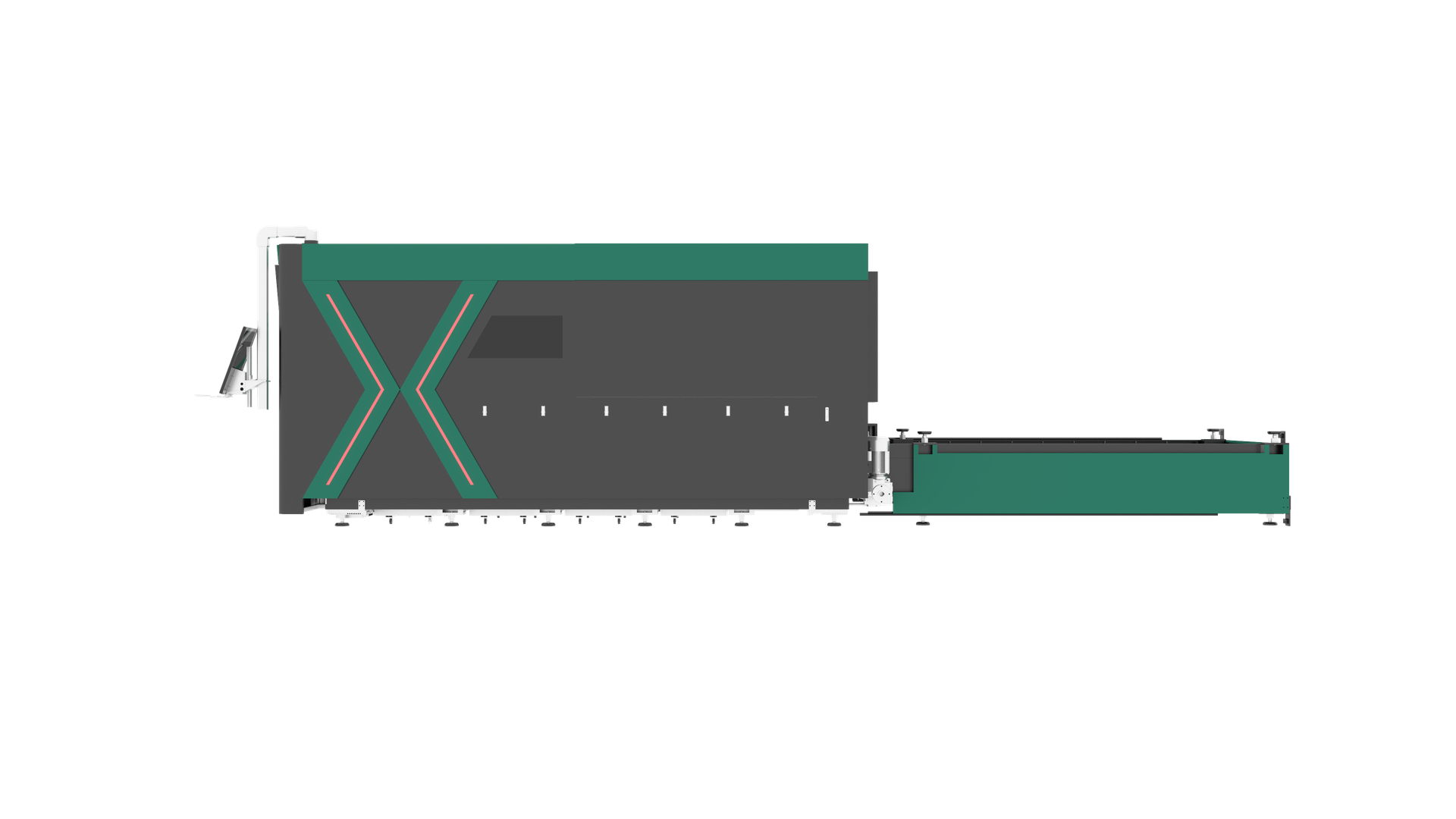
The Vantix FLC line is fiber laser sheet and plate cutting for Canadian shops running production duty cycles rather than occasional jobs. Power is configurable across eight steps: 3, 6, 10, 12, 20, 30, 40 and 60 kW. The standard cutting area is 5 ft x 10 ft (1.5 m x 3 m), and the platform is configurable up to 12 ft x 60 ft.
Every maximum thickness Vantix publishes for the FLC is measured at 60 kW. At 60 kW the line cuts steel up to 5 in (127 mm), stainless up to 3.5 in (89 mm) and aluminum up to 2.5 in (64 mm). A 3 kW or 6 kW machine will not cut 5 in steel. Vantix publishes no thickness figures for any power level below 60 kW, so if you are sizing a 6 kW or 12 kW system, ask for the thickness chart for that specific configuration rather than scaling down from the 60 kW numbers.
Positioning accuracy is 0.03 mm and maximum positioning speed is 450 ft/min. Motion runs on YASKAWA high-performance servos over 35 mm black-chrome-plated Airtac linear guides, on a 12 mm welded steel bed that is stress-relieved and FEA-checked. Dust collection is zoned and PLC-controlled. Materials supported are steel, stainless, aluminum, copper, brass and titanium. Files come in as DWG, DXF and other industry-standard formats.
Two-year warranty, five days of on-site training, a one-year spare parts kit stocked in Lumby, British Columbia, a 24/7 Canadian support line, and a 48-hour on-site response commitment across Western Canada. Parts are stocked in Lumby, not overseas.
If you are cutting on plasma today, the honest side-by-side is on plasma cutter versus laser cutter. To put numbers against your own outsourcing spend, use the laser cutting machine ROI page. The full line overview sits at fiber laser cutting, and lease and finance-to-own programs are set out on the financing page.
Bring your drawings and your material to the Lumby, BC showroom and watch this machine run your part before you sign anything. Book a demo.
A fiber laser is only as good as the frame it sits on and the motion system that drives it. Every Vantix system is built on an industrial-grade foundation with named, serviceable parts.
Stress-relieved for long-term accuracy.
A half-inch welded steel plate bed, FEA-optimized for load distribution and torsional rigidity, then stress-relief annealed and CNC-machined to a unified reference surface.
Targeted extraction — not a blunt instrument.
Solenoid dampers open and close in real time, synchronized with the cutting head. Airflow paths are CFD-optimized with angled baffles and flow straighteners.
Global-standard drives.
The same drive architecture used on top-tier CNC machinery worldwide — high-resolution encoders, adaptive tuning, and built-in vibration suppression during rapid acceleration.
Read every thickness figure below with its power level attached. All three maximum thicknesses are published at 60 kW. Vantix publishes no thickness data for the 3, 6, 10, 12, 20, 30 or 40 kW configurations, and these figures must not be read down to a lower-power machine.
| Category | Specification |
|---|---|
| Laser power | 3 / 6 / 10 / 12 / 20 / 30 / 40 / 60 kW |
| Cutting area (standard) | 5 ft × 10 ft (1.5 m × 3 m) |
| Cutting area (configurable) | up to 12 ft × 60 ft |
| Max steel thickness | up to 5 in (127 mm) @ 60 kW |
| Max stainless thickness | up to 3.5 in (89 mm) @ 60 kW |
| Max aluminum thickness | up to 2.5 in (64 mm) @ 60 kW |
| Positioning accuracy | ± 0.03 mm |
| Max positioning speed | 450 ft/min |
| Motion control | YASKAWA high-performance servos |
| Linear guides | Airtac 35 mm, black-chrome plated |
| Machine bed | 12 mm welded steel, stress-relieved (FEA) |
| Exhaust | PLC-controlled zoned dust collection |
| Materials | Steel, stainless, aluminum, Cu, brass, Ti |
| CAD/CAM | DWG · DXF · industry-standard |
| Warranty + training | 2 yr · 5-day on-site |
| Parts + support | 1-yr spares stocked BC · 24/7 Canadian |
| Service SLA | 48-hr on-site (Western Canada) |
Thickness at any power level other than 60 kW is not published and is therefore absent from this table.
Not published by Vantix for this line and therefore not listed here: laser source brand, CNC control system, electrical supply (voltage, phase, frequency), machine footprint and machine weight. Vantix's own spec sheet is the only source used for this table.
Vantix fiber laser cutting systems are offered in 3, 6, 10, 12, 20, 30, 40 and 60 kW configurations.
Higher power does more than extend maximum thickness. It also raises cutting speed on thinner material, so the right choice depends on your thickest regular part, your material mix, and how many hours a day the machine needs to be productive. Shops running mostly light and medium gauge often land lower in the range; plate-heavy and high-throughput shops land higher.
Send us a representative part mix and we will suggest a starting configuration.
The standard cutting area is 5 ft x 10 ft (1.5 m x 3 m), and the platform is configurable up to 12 ft x 60 ft.
Bed size is usually driven by the stock you buy rather than the parts you cut. If you already purchase oversized plate, a larger bed removes a cut-to-size step upstream. If you buy standard sheet, the standard bed is normally the better use of floor space, and the money is better spent on power.
At the top 60 kW configuration, published capability is up to 5 in (127 mm) in steel, up to 3.5 in (89 mm) in stainless, and up to 2.5 in (64 mm) in aluminum.
Two cautions on those numbers. They are maximums for the highest power level in the range, not a general figure, and a lower-power machine cuts proportionally thinner. Maximum thickness and production-speed thickness are also different numbers, and the second one usually matters more to a shop that has to hit a delivery date.
Ask us to confirm the figures against the documentation for the specific configuration you are considering.
Vantix fiber laser sheet cutting systems hold a positioning accuracy of plus or minus 0.03 mm.
In practice that shows up as consistent part-to-part repeatability across a nest, and less fettling downstream. It matters most on assemblies where several cut parts have to fit together, because tolerance stack-up is what turns a small deviation into a fit-up problem at the weld bench.
If tolerance is the deciding factor for you, the most useful test is your own part cut on the machine, not a spec line.
Vantix fiber lasers cut steel, stainless steel, aluminum, copper, brass and titanium.
Material capability and thickness capability are two separate questions. A machine that cuts a metal at all will not cut every gauge of it, and achievable thickness varies with the power level configured on your machine. Tell us the metals and gauges you run most often and we will confirm what a given configuration will hold in production, rather than at its maximum.
On comparable material, fiber laser cutting runs up to 80% faster than plasma, and holds a much tighter positioning accuracy of plus or minus 0.03 mm with a smaller heat-affected zone.
The practical differences are edge quality and secondary work. Laser-cut edges usually need less dressing before welding or finishing, and a narrower kerf allows tighter nesting and better material yield across a sheet.
Plasma still has a real cost argument on very heavy plate where edge quality is not critical and the parts go straight to a structural weld. The honest comparison is your part mix, not a headline number.
Yes, and it is worth doing. The showroom in Lumby, British Columbia has cutting, welding and cleaning systems available to run.
Bring your own material and your own drawings. A machine cutting a vendor's demo part tells you very little, because that part was chosen to suit the machine. The same machine cutting your part, at your thickness, in your alloy, tells you almost everything you need to know.
Book ahead so the right configuration is set up and the material is ready when you arrive.
Financing can be arranged, and it is worked through during the quote process.
We do not publish fixed rates, terms or payment examples here, for a straightforward reason: they depend on the system, the structure you want, your business and the lender, so any number shown on this page would not be the number on your agreement. Publishing one would only make the real quote look like a change of terms.
Ask for financing to be included when you request a quote and it will be worked out alongside the machine specification.