
4x faster than traditional welding. Days of training, not months. See the MX A15 in real shop conditions.

Three power levels, published Canadian prices. These are starting prices for real configurations, not quote-only teasers.
Beyond the sticker price: consumables, safety gear and training are covered in what a handheld laser welder costs in Canada.
Specification
Vantix handheld laser welding
Cooling configurations
Air-cooled 1.5 kW / 2 kW / 3 kW · Water-cooled 2 kW / 3 kW
Max weld thickness, 1.5 kW
Up to 0.24 in (6 mm)
Max weld thickness, 2 kW
Up to 0.31 in (8 mm)
Max weld thickness, 3 kW
Up to 0.39 in (10 mm)
Handheld head weight
~0.58 kg air-cooled · ~0.68 kg water-cooled
4-in-1 head modes
Weld · clean · light cut · seam-clean
Wire feed
Single-wire standard · dual-wire optional
Ferrous materials
Stainless · carbon steel · galvanized
Non-ferrous materials
Aluminum · copper and brass at 3 kW (air- or water-cooled)
Warranty
2 years, on every system
Starting price
From $32,000 CAD
Copper and brass are qualified by power, not by cooling. The 3 kW step covers them in both the air-cooled and the water-cooled configuration.
Exact electrical service requirements are confirmed per configuration. Ask for them in writing with your quote, before you order.
Full platform breakdown by power level and cooling: HLW handheld platform specifications
If you are shopping handheld laser welding seriously, your shortlist probably includes Miller's OptX line and IPG's LightWELD. Both are credible machines from credible companies, and we would rather you compare than guess.
Here is what Vantix puts on the table, in writing: a published price ladder starting at $32,000 CAD, a 2-year warranty on every system, 5-day on-site training, a 1-year spare parts kit, installation and commissioning included, parts stocked in Lumby, BC, and a 48-hour on-site response commitment across Western Canada. Ask every vendor on your shortlist for the same list in writing, then compare.
The full spec-for-spec comparison is published: Vantix vs Miller OptX. More laser welding guides are on the insights index.
Air-cooled and water-cooled overlap at 2 kW and 3 kW, so this is not a power decision. It is a decision about duty cycle and mobility.
Power sets what you can weld: up to 6 mm at 1.5 kW, 8 mm at 2 kW, 10 mm at 3 kW, and copper or brass only at 3 kW. Choose the power level your thickest joint and your material list demand. The cooling decision comes after, and it changes none of those numbers.
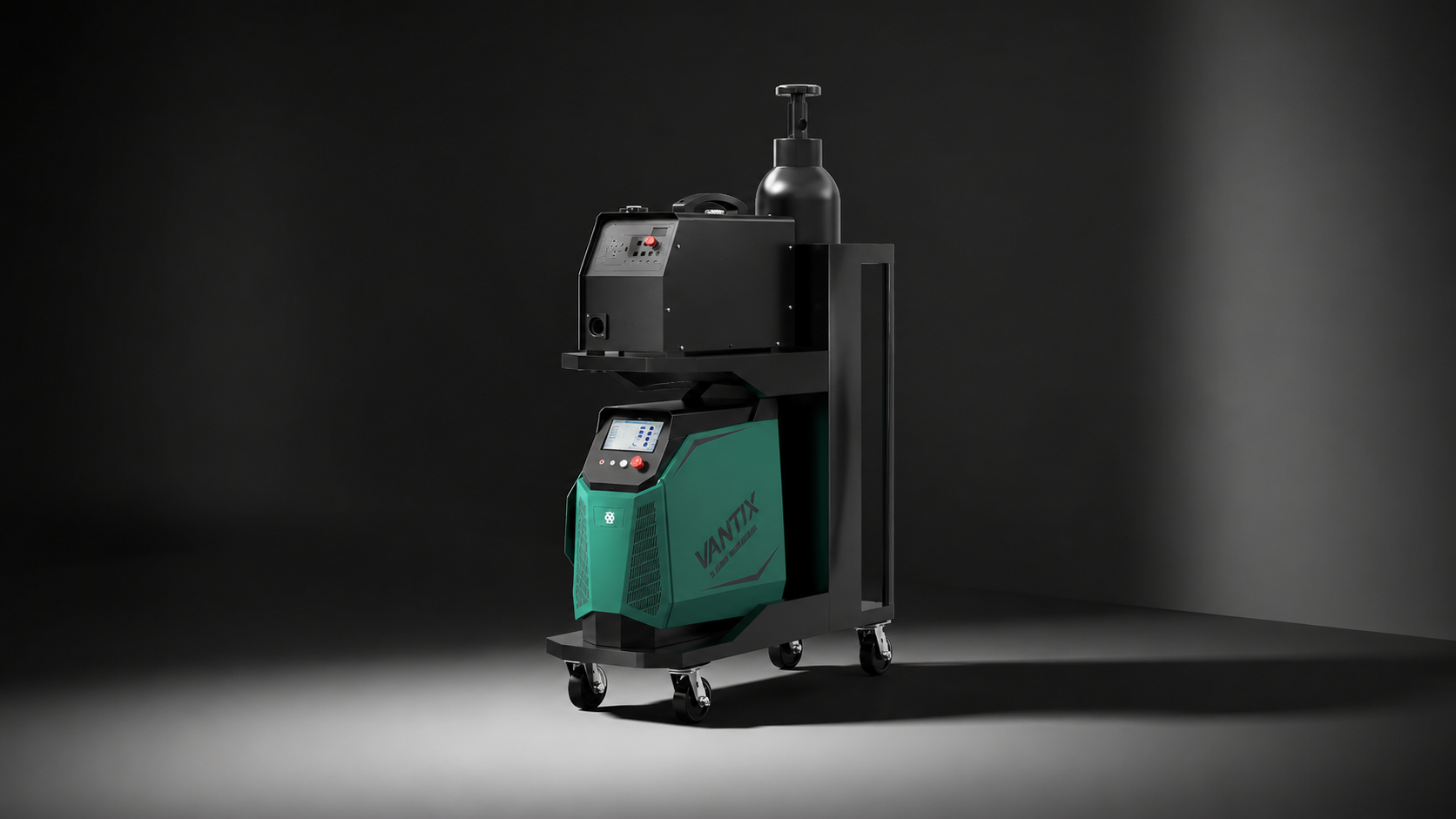
Available at 1.5, 2 and 3 kW. No chiller to plumb in and nothing to top up, and the source, wire feeder and gas cylinder travel together on one wheeled platform. Right for a shop welding between other operations, doing on-site repair work, or bringing laser welding in for the first time.
Available at 2 and 3 kW. Closed-loop cooling holds output steady when the gun runs back-to-back for hours in a dedicated cell. You take on a chiller and its maintenance in exchange for a duty cycle that does not have to ease off.
At 2 kW and at 3 kW you can have either one. Same 4-in-1 head, same max weld thickness, same materials, same single- or dual-wire feed, same 2-year warranty and the same Canadian support. What is left to decide is how hard you will run it and whether it has to move.
If the welder has to move around the floor, go air-cooled. If it lives in one cell and runs most of the shift, go water-cooled. Then set the power level from your thickest joint.
For most shops this is the argument that decides the purchase, and it has almost nothing to do with laser physics.
What you are comparing
The number
Qualified TIG welder
$75,000 to $110,000 CAD per year, plus benefits
Time to competence, TIG
Months of supervised training
Vantix handheld laser welder
From $32,000 CAD, once
Time to competence, laser
Days, at operator-level wages
Welding speed
4x faster than MIG / TIG
A qualified TIG welder costs $75,000 to $110,000 CAD a year in wages, before benefits. A Vantix handheld laser welding system starts at $32,000 CAD, once. The equipment is bought and paid for before the welder you could not hire would have finished their first year.
Experienced welders are retiring faster than the trade replaces them, and the qualified candidates still out there have options. Laser welding moves the work from a scarce trade skill to an operator skill your existing team can pick up, which is a hiring problem you can actually solve.
TIG asks an operator to read a molten puddle and correct it in real time, and that judgement takes months to build. Handheld laser welding asks for a consistent travel speed and a steady stand-off distance. Both can be demonstrated, practised on scrap and objectively checked by a supervisor.
Laser welding does not remove the need for skilled people, and nobody runs every joint geometry and material combination unsupervised in week one. What changes is the constraint: from finding and affording a certified TIG welder, to getting a fabricator you already employ productive on a new tool.
The full ramp, week by week: how long it takes to train a laser welding operator

Laser welding only solves your labour problem if the head is light enough to use all day and the platform covers the work you actually run. Here is what ships, from the published spec sheet.

Materials: stainless, carbon steel and galvanized among ferrous metals; aluminum, plus copper and brass at the 3 kW power level. Copper and brass are qualified by power, not by cooling.
Vantix engineers, installs, commissions, trains and supports from Lumby, British Columbia. When a machine stops, the parts are already in the province and the person who answers the phone is an engineer.
Commitment
What Vantix provides
Warranty
2-year extended warranty, on every system
Spare parts
Stocked in Lumby, BC — not overseas
Spare parts kit
1-year spare parts kit included
Support line
24/7 Canadian hotline
On-site service
Training
5-day on-site training
Handover
Installation and commissioning included
See how Canadian shops structure it: laser equipment financing
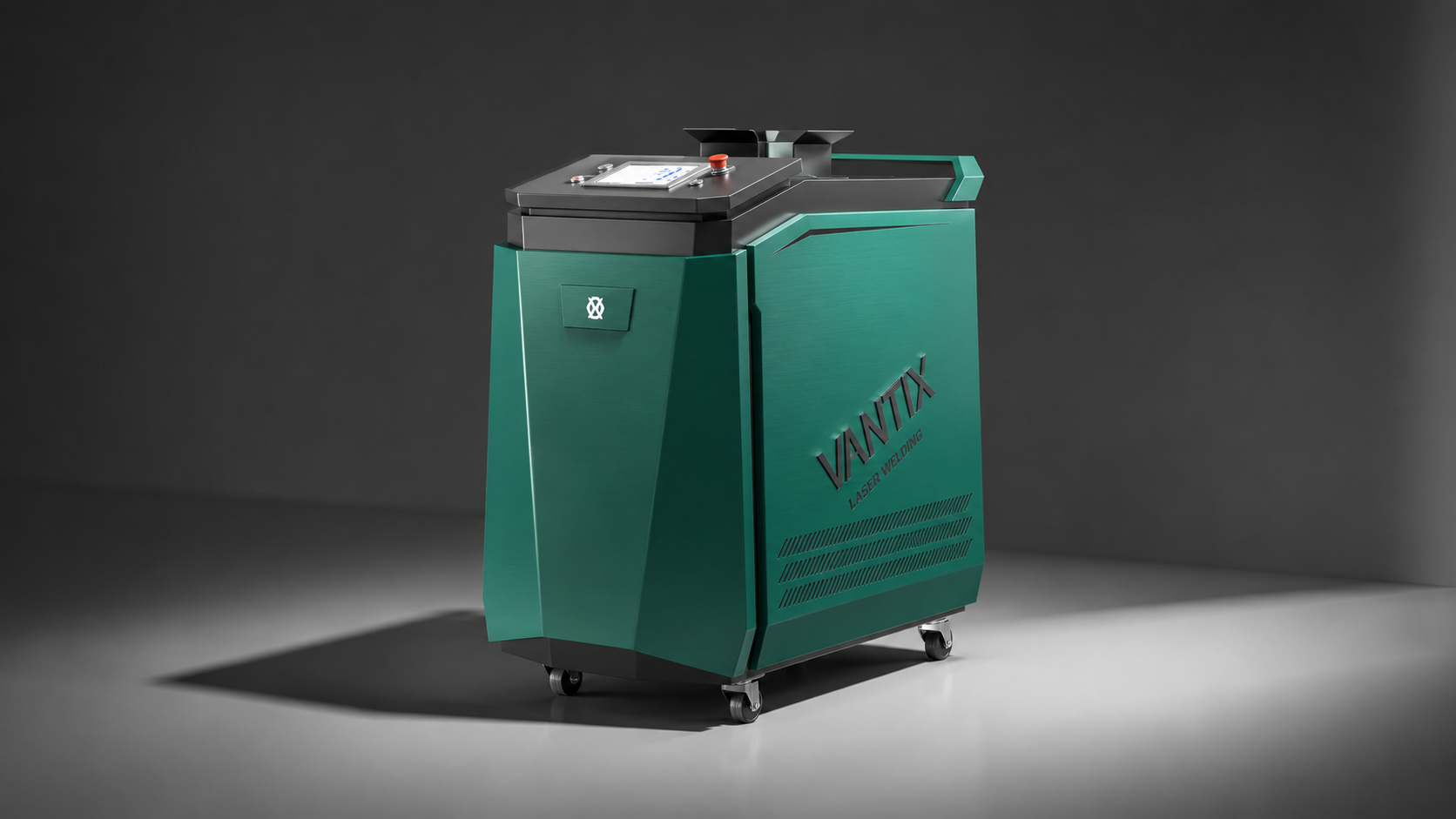
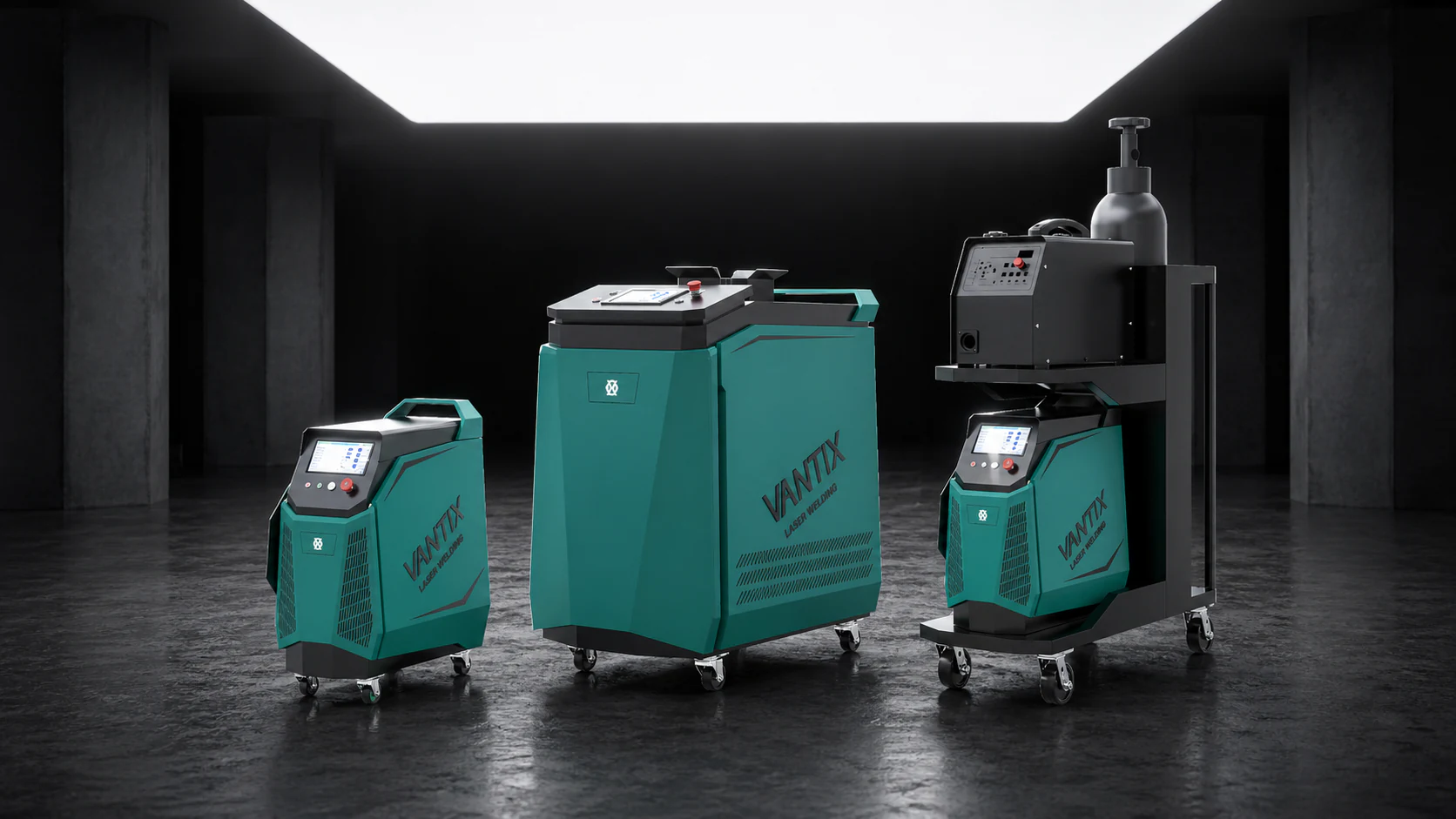
Vantix handheld laser welders are available air-cooled in 1.5, 2 and 3 kW, and water-cooled in 2 and 3 kW. Cooling type is a separate decision from power: air-cooled units are lighter and easier to move around a shop or between sites; water-cooled units are built for sustained high-duty-cycle production. Both configurations ship with the same 4-in-1 multi-function head.
Single-pass capability is up to 0.24 in (6 mm) at 1.5 kW, up to 0.31 in (8 mm) at 2 kW, and up to 0.39 in (10 mm) at 3 kW. Most shops buy on the joints they run every day rather than the thickest joint they can imagine: laser welding's advantage is largest on thinner material, where conventional heat input causes the distortion that forces straightening and rework.
Stainless steel, carbon steel and galvanized steel, plus aluminum. Copper and brass are supported at 3 kW. The low heat input also makes the process practical in places conventional welding struggles: near heat-sensitive components, on thin-to-thick joints, and on finished or coated assemblies where distortion would be visible.
The handheld head runs four modes: weld, clean, light cut and seam-clean. The cleaning modes matter more than they sound: pre-weld cleaning and post-weld seam cleaning are normally separate operations with separate equipment, so doing them with the same head means the part does not move between stations and the operator does not change tools between steps. Single-wire feed is standard, with dual-wire available as an option.
Handheld laser welding runs about 4 times faster than MIG or TIG on comparable joints, with much lower heat input and correspondingly less distortion and finishing work. On thin stainless the finishing time saved is often larger than the welding time saved, which is why a straight arc-time comparison usually understates the difference.
Operators reach working proficiency in days. TIG takes months. That difference separates your welding capacity from the supply of certified welders, so you can add output without competing for a labour pool that is not growing. Results are also more consistent between operators, because much less of the outcome depends on hand technique.
Vantix handheld laser welding starts from $32,000 CAD, with the 2 kW air-cooled configuration from $42,000 CAD and the 3 kW platform from $52,000 CAD. Where a system lands depends on the power level, the cooling configuration and whether you take the optional dual-wire feeder. Lease and finance options are available.
You call a 24/7 Canadian hotline. Spare parts are stocked in Lumby, British Columbia, and Vantix commits to a 48-hour on-site response across Western Canada. Every system carries a 2-year extended warranty and ships with a 1-year spare parts kit.
Speed, training time and cost set side by side, with the numbers Vantix stands behind.
The published spec sheet for handheld laser welding, plus documentation for every other Vantix system.
The full cooling comparison: what changes, what does not, and which one your duty cycle calls for.
What max weld thickness actually means, why it scales with power, and how joint type changes the answer.
What transfers from a TIG background, what does not, and a realistic first-two-weeks ramp.
What to confirm in writing about your electrical service before you commit to a configuration.
The full specification page for the handheld platform, broken out by power level and cooling configuration.
Beyond the sticker: consumables, safety gear, training, and what the comparison to hiring looks like.
Where the speed and heat-input advantage shows up, and where MIG still wins on thick fill and field work.