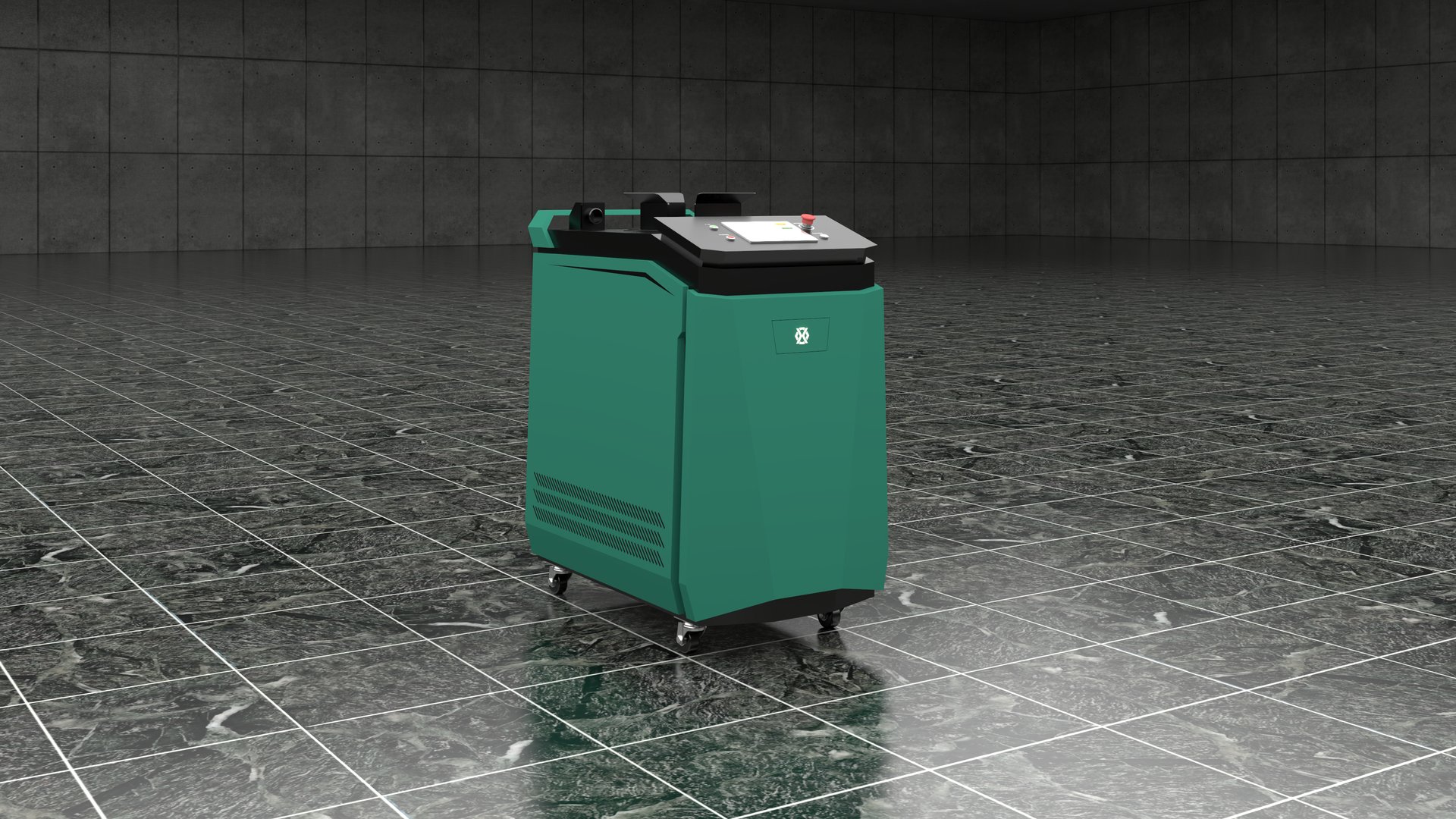
The Vantix LCC removes rust, paint, coatings, oxide and contaminants selectively, leaving the substrate you want to keep. No grit, no chemicals, no hazardous waste stream and no spent-media disposal. The line reaches SP-10 near-white blast standard.
Continuous is sold at 2 kW and 3 kW and is the choice for high-throughput industrial refurbishment. It carries integrated water cooling, an air-knife guard on the optics, and a scan width up to 300 mm. Pulsed is sold at 200 W, 300 W, 500 W, 1000 W and 2000 W and is the choice for precision work, heritage restoration and mould cleaning. Within the pulsed series, cooling follows power: 200 W and 300 W are air-cooled, while 500 W, 1000 W and 2000 W are water-cooled. Eight selectable cleaning patterns are available, including line, square, circle and wave, and a dual red-light preview lets an operator scan the path before firing.
Metals supported are steel, stainless, aluminum, bronze and titanium. The pulsed series adds heritage substrates: cast iron, stone, concrete and wood. Control is by touchscreen HMI with a dynamic alarm display, and the line is automation-ready over EtherCAT or Profinet. Typical work is weld preparation, paint and rust stripping, mould cleaning, heritage restoration, mining and MRO refurbishment, and general surface prep to SP-10.
The Kamloops Heritage Railway Society in Kamloops, BC reported that Vantix laser cleaning “saved a couple of weeks of work, completed in just three hours” on the Spirit of Kamloops restoration, adding that the precision was exactly what a heritage project demands.
Two-year warranty, spare parts stocked in Lumby, British Columbia, a 24/7 Canadian support line, and a 48-hour on-site response commitment across Western Canada. Parts are stocked in Lumby, not overseas.
The full line overview is at industrial laser cleaning systems. Shop context for surface prep ahead of cutting and welding is on metal fabrication solutions, and lease and finance-to-own programs are on the financing page.
Send a rusted, painted or coated sample to the Lumby, BC showroom and see the result before you buy. Book a demo.
A fiber laser is only as good as the frame it sits on and the motion system that drives it. Every Vantix system is built on an industrial-grade foundation with named, serviceable parts.
Stress-relieved for long-term accuracy.
A half-inch welded steel plate bed, FEA-optimized for load distribution and torsional rigidity, then stress-relief annealed and CNC-machined to a unified reference surface.
Targeted extraction — not a blunt instrument.
Solenoid dampers open and close in real time, synchronized with the cutting head. Airflow paths are CFD-optimized with angled baffles and flow straighteners.
Global-standard drives.
The same drive architecture used on top-tier CNC machinery worldwide — high-resolution encoders, adaptive tuning, and built-in vibration suppression during rapid acceleration.
The LCC is two series, not one machine. Continuous is the throughput choice; pulsed is the precision choice. Cooling follows power within the pulsed series: 200 W and 300 W are air-cooled, 500 W, 1000 W and 2000 W are water-cooled.
| Category | Specification |
|---|---|
| Continuous series power | 2 kW · 3 kW |
| Continuous series cooling | Integrated water cooling |
| Continuous series max scan width | up to 300 mm |
| "Air knife" protection | Optics guarded against contamination |
| Pulsed series power options | 200 W · 300 W · 500 W · 1000 W · 2000 W |
| Pulsed series cooling | Air-cooled (200–300 W) · Water-cooled (500 / 1000 / 2000 W) |
| Selectable cleaning patterns | 8 (line, square, circle, wave, and more) |
| Surface prep standard | up to SP-10 near-white blast |
| Dual red-light preview | Scan before firing |
| HMI + diagnostics | Touchscreen · dynamic alarm display |
| Automation | EtherCAT / Profinet ready |
| Metals | Steel · stainless · aluminum · bronze · Ti |
| Heritage substrates (pulsed) | Cast iron · stone · concrete · wood |
| Warranty | 2 yr |
| Parts + support | Spares stocked BC · 24/7 Canadian |
| Service SLA | 48-hr on-site (Western Canada) |
Five pulsed power options are published: 200 W, 300 W, 500 W, 1000 W and 2000 W. Vantix's trifold brochure lists only 300 W and 500 W because it is a one-line summary across five product lines; the dedicated cleaning spec sheet is the authority for this line and is the source used here.
Not published by Vantix for this line and therefore not listed here: laser source brand, CNC control system, electrical supply (voltage, phase, frequency), machine footprint and machine weight.
Two series. Continuous-wave systems come in 2 and 3 kW for high-throughput industrial refurbishment. Pulsed systems come in 200 W, 300 W, 500 W, 1000 W and 2000 W for precision work, mold cleaning and heritage restoration.
Continuous is chosen for area covered per hour. Pulsed is chosen for control over how much energy reaches a delicate substrate, which is what makes it usable on surfaces a continuous beam would mark.
Pulsed units at 200 to 300 W are air-cooled; 500 W and above are water-cooled.
Laser cleaning works by selective absorption. Contaminants such as rust, paint, coatings and oxide absorb the laser energy and vaporize, while the underlying metal reflects far more of it and is left intact.
Because nothing touches the surface, there is no abrasive media, no chemical stripper, and no contaminated grit or chemical runoff to dispose of afterward. What comes off is captured as particulate rather than mixed into spent blast media, which is usually the larger disposal problem.
The practical consequence is that cleaning can happen in places blasting cannot: indoors, near assembled equipment, and on parts that cannot be moved to a booth.
Yes. Vantix laser cleaning systems reach up to SP-10 near-white metal blast standard.
That is the surface preparation level most industrial coating specifications call for, which means laser cleaning can satisfy the specification itself rather than serving only as a touch-up method between blast operations.
The difference in practice is containment. Reaching the same standard without grit means no blast enclosure, no media recovery and no contaminated abrasive to dispose of, which is often what decides whether prep can be done in-house at all.
The most common uses are weld preparation, paint and rust stripping, mold cleaning, heritage restoration, and mining and MRO equipment refurbishment.
Supported substrates include steel, stainless, aluminum, bronze and titanium. Pulsed systems extend to cast iron, stone, concrete and wood, which is what makes restoration and masonry work practical rather than only metal cleaning.
If you have a surface that is currently blasted, stripped with chemicals, or cleaned by hand, it is worth testing on a sample before assuming which category it falls into.
Yes. Both series are automation-ready over EtherCAT and Profinet, so the head can be mounted on a robot or gantry and driven from a cell controller rather than held by an operator.
Operator-facing controls include eight selectable scan patterns, a maximum scan width of 300 mm, and a touchscreen HMI with dynamic alarm display. Dual red-light preview shows the scan area before the laser fires, which matters as much in a fixed cell as in the hand: it is how you confirm the part is positioned correctly without a test pass.
Four things tell us almost everything: the materials you run, the thickness range, your monthly volume, and where the current bottleneck actually is.
That last one matters most and is the one most often skipped. A shop that is slow because tube prep is manual does not need a faster sheet cutter, and a shop losing days to weld distortion does not need more cutting capacity. Buying against a bottleneck you have not identified is the most common way a good machine produces a disappointing result.
Send those four and we will recommend a starting configuration rather than guessing at a model.
Yes, and it is worth doing. The showroom in Lumby, British Columbia has cutting, welding and cleaning systems available to run.
Bring your own material and your own drawings. A machine cutting a vendor's demo part tells you very little, because that part was chosen to suit the machine. The same machine cutting your part, at your thickness, in your alloy, tells you almost everything you need to know.
Book ahead so the right configuration is set up and the material is ready when you arrive.
Financing can be arranged, and it is worked through during the quote process.
We do not publish fixed rates, terms or payment examples here, for a straightforward reason: they depend on the system, the structure you want, your business and the lender, so any number shown on this page would not be the number on your agreement. Publishing one would only make the real quote look like a change of terms.
Ask for financing to be included when you request a quote and it will be worked out alongside the machine specification.