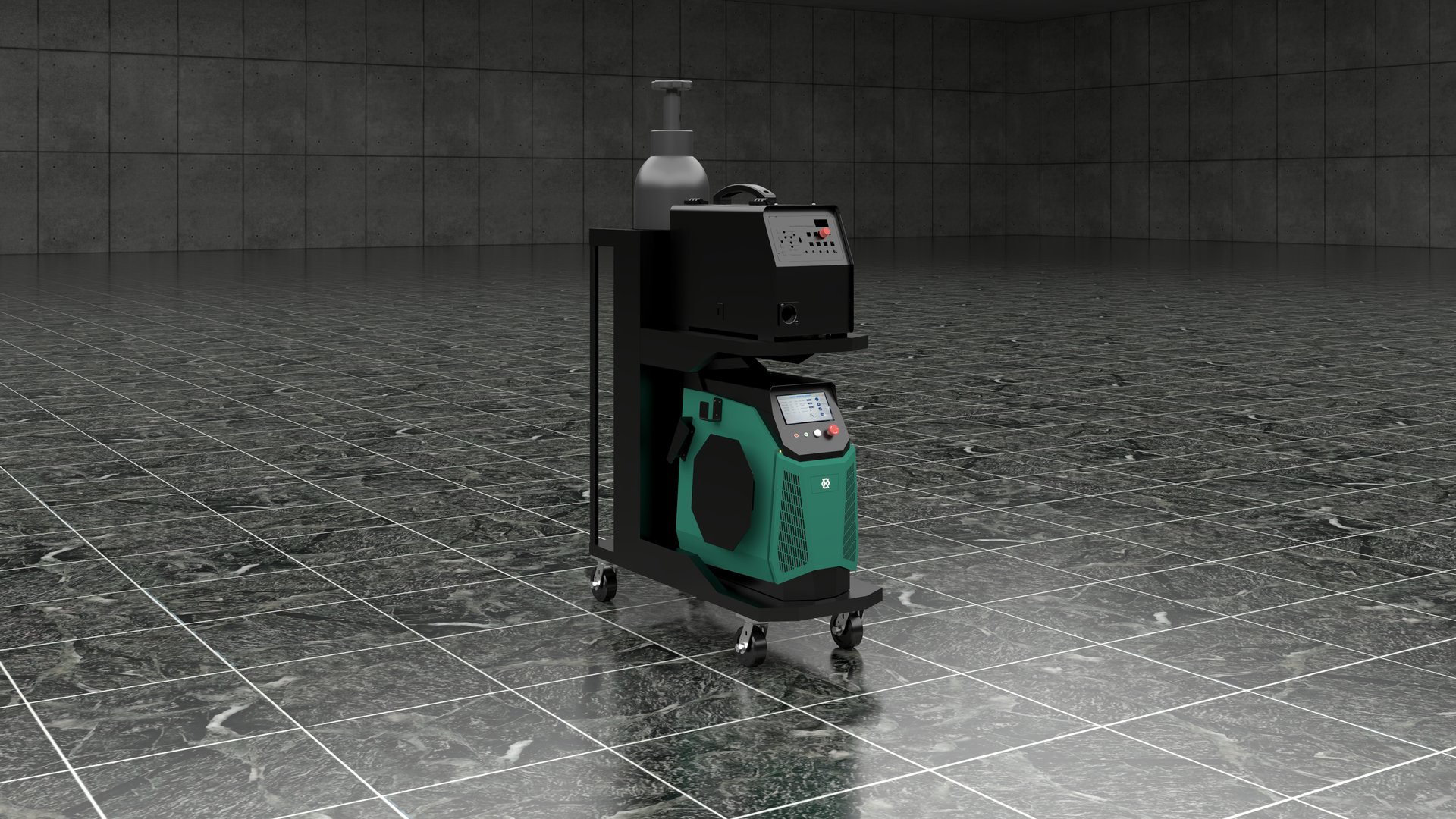
The Vantix HLW is a handheld laser welding platform sold in five configurations: air-cooled at 1.5, 2 and 3 kW, and water-cooled at 2 and 3 kW. Both cooling types ship the same 4-in-1 head, which welds, cleans, light-cuts and seam-cleans.
Power sets weld thickness, and Vantix publishes the ladder explicitly: 1.5 kW welds up to 0.24 in (6 mm), 2 kW up to 0.31 in (8 mm), and 3 kW up to 0.39 in (10 mm). The published starting prices track the same ladder: from $32,000 CAD at 1.5 kW, from $42,000 CAD for the 2 kW air-cooled handheld, and from $52,000 CAD for the 3 kW platform.
Cooling is a duty-cycle decision, not a capability one. Air-cooled suits mobile shop use and needs no external chiller. Water-cooled suits sustained high-duty-cycle production. Cooling does not restrict what you can weld. Copper and brass are qualified at 3 kW, and 3 kW is sold in both air-cooled and water-cooled form. Stainless, carbon steel, galvanized and aluminum are supported across the range. The head weighs about 0.58 kg air-cooled and about 0.68 kg water-cooled. Wire feed is single-wire as standard, with dual-wire optional.
Vantix positions this line against the welder shortage rather than against another machine. Laser welding runs roughly 4 times faster than MIG or TIG and operators are trained in days rather than months, while a qualified TIG welder costs $75,000 to $110,000 a year plus benefits plus months of training. Minimal heat input means near-zero warp on thin sheet and welds that skip post-weld finishing.
Two-year warranty, spare parts stocked in Lumby, British Columbia, a 24/7 Canadian support line, and a 48-hour on-site response commitment across Western Canada. Parts are stocked in Lumby, not overseas.
The full line overview is at handheld laser welding machines. For the process comparison most buyers run first, see laser welding versus TIG. Lease and finance-to-own programs are on the financing page.
Bring your joint, your material and your operator to the Lumby, BC showroom. A coupon bead proves nothing; your part proves everything. Book a demo.
A fiber laser is only as good as the frame it sits on and the motion system that drives it. Every Vantix system is built on an industrial-grade foundation with named, serviceable parts.
Stress-relieved for long-term accuracy.
A half-inch welded steel plate bed, FEA-optimized for load distribution and torsional rigidity, then stress-relief annealed and CNC-machined to a unified reference surface.
Targeted extraction — not a blunt instrument.
Solenoid dampers open and close in real time, synchronized with the cutting head. Airflow paths are CFD-optimized with angled baffles and flow straighteners.
Global-standard drives.
The same drive architecture used on top-tier CNC machinery worldwide — high-resolution encoders, adaptive tuning, and built-in vibration suppression during rapid acceleration.
Weld thickness on this line is set by power, not by cooling. Both the air-cooled and water-cooled builds ship the same 4-in-1 head. Copper and brass are qualified at 3 kW, which is available in both air-cooled and water-cooled form.
| Category | Specification |
|---|---|
| Air-cooled power | 1.5 kW · 2 kW · 3 kW |
| Water-cooled power | 2 kW · 3 kW |
| Max weld thickness (1.5 kW) | up to 0.24 in (6 mm) |
| Max weld thickness (2 kW) | up to 0.31 in (8 mm) |
| Max weld thickness (3 kW) | up to 0.39 in (10 mm) |
| Handheld head weight (air) | ~ 0.58 kg |
| Handheld head weight (water) | ~ 0.68 kg |
| Modes | Weld · clean · light cut · seam-clean |
| Wire feed | Single-wire std · dual-wire optional |
| Ferrous materials | Stainless · carbon steel · galvanized |
| Non-ferrous materials | Aluminum · copper / brass (3 kW) |
| Warranty | 2 yr |
| Parts + support | Spares stocked BC · 24/7 Canadian |
| Service SLA | 48-hr on-site (Western Canada) |
| Configuration | Weld thickness | Published starting price |
|---|---|---|
| 1.5 kW handheld | up to 0.24 in (6 mm) | from $32,000 CAD |
| 2 kW air-cooled handheld | up to 0.31 in (8 mm) | from $42,000 CAD |
| 3 kW platform | up to 0.39 in (10 mm) | from $52,000 CAD |
Prices are published starting prices for the configurations named above. Water-cooled 2 kW and 3 kW pricing is not separately published.
Machine weight and footprint are not published for this line; the weights above are handheld head weights only. Laser source brand, CNC control system and electrical supply (voltage, phase, frequency) are not published by Vantix.
Vantix handheld laser welders are available air-cooled in 1.5, 2 and 3 kW, and water-cooled in 2 and 3 kW.
Cooling type is a separate decision from power. Air-cooled units are lighter and easier to move around a shop or between sites; water-cooled units are built for sustained high-duty-cycle production. The deciding question is usually how much of the shift the welder is actually running, not how thick the material is.
Both configurations ship with the same 4-in-1 multi-function head.
Single-pass capability is up to 0.24 in (6 mm) at 1.5 kW, up to 0.31 in (8 mm) at 2 kW, and up to 0.39 in (10 mm) at 3 kW.
Most shops buy on the joints they run every day rather than the thickest joint they can imagine. Laser welding's advantage is largest on thinner material, where conventional heat input causes the distortion that forces straightening and rework, so sizing up for an occasional heavy joint often buys capability in the wrong place.
The handheld head runs four modes: weld, clean, light cut and seam-clean.
The cleaning modes matter more than they sound. Pre-weld cleaning and post-weld seam cleaning are normally separate operations with separate equipment, so doing them with the same head means the part does not move between stations and the operator does not change tools between steps.
Single-wire feed is standard, with dual-wire available as an option.
Handheld laser welding runs about 4 times faster than MIG or TIG on comparable joints.
The speed comes from a concentrated energy source and much lower heat input. The lower heat input is arguably the bigger effect: less distortion on thin sheet means less post-weld straightening, and cleaner welds mean less grinding and polishing.
On thin stainless the finishing time saved is often larger than the welding time saved, which is why a straight arc-time comparison usually understates the difference.
Operators reach working proficiency in days. TIG takes months.
That difference is the main reason shops buy the technology. It separates welding capacity from the supply of certified welders, so you can add output without competing for a labour pool that is not growing.
Results are also more consistent between operators, because much less of the outcome depends on hand technique. That tends to matter most on repeat production work, where variation between welders shows up as variation in the finished product.
Stainless steel, carbon steel and galvanized steel, plus aluminum. Copper and brass are supported at 3 kW.
The low heat input also makes the process practical in places conventional welding struggles: near heat-sensitive components, on thin-to-thick joints, and on finished or coated assemblies where distortion would be visible.
Yes, and it is worth doing. The showroom in Lumby, British Columbia has cutting, welding and cleaning systems available to run.
Bring your own material and your own drawings. A machine cutting a vendor's demo part tells you very little, because that part was chosen to suit the machine. The same machine cutting your part, at your thickness, in your alloy, tells you almost everything you need to know.
Book ahead so the right configuration is set up and the material is ready when you arrive.
Financing can be arranged, and it is worked through during the quote process.
We do not publish fixed rates, terms or payment examples here, for a straightforward reason: they depend on the system, the structure you want, your business and the lender, so any number shown on this page would not be the number on your agreement. Publishing one would only make the real quote look like a change of terms.
Ask for financing to be included when you request a quote and it will be worked out alongside the machine specification.